



How can motor EPS packaging be designed to facilitate quick and easy installation and removal of motors?
Release Time : 2026-02-24
The design of motor EPS packaging must balance protection and ease of operation, especially in the rapid loading and unloading process. Efficient operation requires structural optimization, utilization of material properties, and user-friendly design. EPS (expanded polystyrene) is widely used in motor packaging due to its lightweight and excellent cushioning properties; however, its insufficient rigidity and fragility need to be compensated for through design. The following discusses how to improve ease of operation from multiple dimensions.
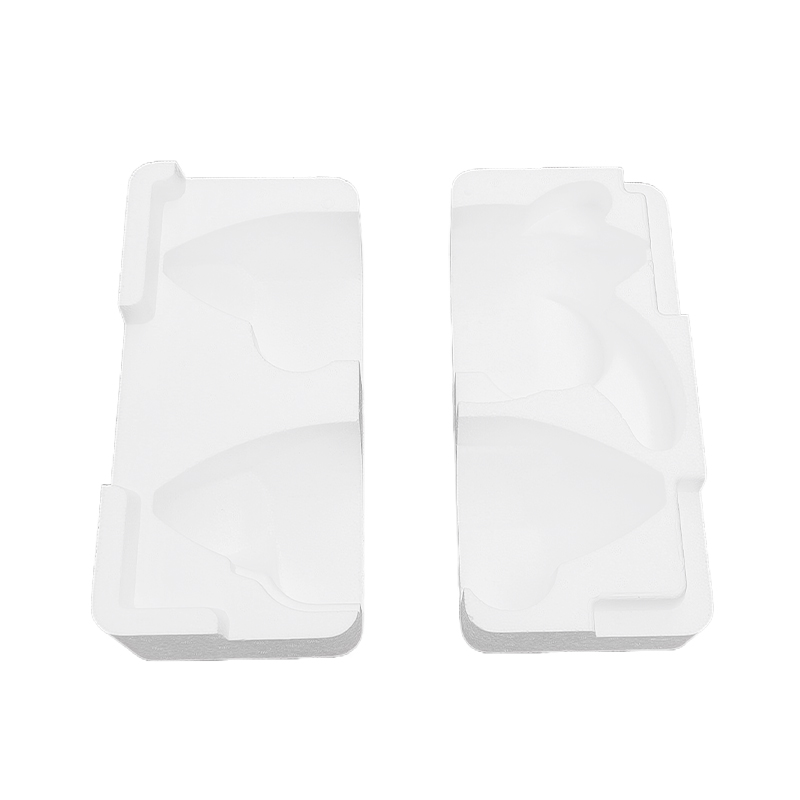
Modular design of the packaging structure is fundamental to improving operational efficiency. Traditional one-piece EPS packaging requires the motor to be completely embedded in the foam. Repeated angle adjustments are necessary during loading and unloading, easily causing damage to the packaging or motor. Modular design breaks down the packaging into two parts or multiple independent components, such as a "top and bottom cover" structure. The top cover and bottom support are fixed by clips or slots. During operation, simply opening the top cover allows direct removal of the motor without complex angle adjustments. Guide grooves or positioning protrusions can be designed between modules to ensure quick alignment and reduce assembly time. Furthermore, modular design facilitates the partial replacement of damaged parts, reducing maintenance costs.
Surface treatment and friction coefficient control directly affect the handling feel. The smooth surface of EPS material can cause the motor to impact the inner wall of the packaging due to inertia during installation, and may slip during removal due to insufficient friction. Friction can be increased by adding texture or coating to the EPS surface, such as using a frosted finish or attaching anti-slip patches. This enhances the relative stability between the motor and the packaging and prevents hand slippage during operation. Simultaneously, it's crucial to balance friction with installation resistance to avoid excessive friction leading to strenuous operation. For heavy-duty motors, cushioning pads can be placed on the inner wall of the packaging to reduce impact while providing adequate friction.
The design of the guiding and positioning structure is key to rapid installation. Precise alignment of the motor and packaging avoids repeated adjustments and reduces operation time. Guide grooves or tapered positioning holes can be incorporated into the packaging, engaging with protrusions or edges on the motor base or housing to guide the motor naturally into the correct position. For example, a V-shaped guide groove can be designed under the EPS support, allowing the motor to automatically center itself as it slides down; or a positioning pin can be installed on the top cover, corresponding to a hole on the top of the motor, enabling rapid positioning during installation. The positioning structure must consider differences in motor models, allowing sufficient adjustment space to prevent jamming due to dimensional deviations. Optimizing opening and closing mechanisms simplifies the operation process. Traditional EPS packaging often uses tape for sealing, requiring the tape to be torn off upon opening, which is time-consuming and not reusable. Detachable fixing structures, such as magnetic closures, snaps, or straps, can be used instead. Magnetic designs are suitable for light motors, using built-in magnets to quickly attract and separate the top cover and bottom tray; snap structures are suitable for medium-sized motors, allowing for quick opening and closing by pressing or sliding the snaps; and strap designs are suitable for heavy motors, securing the packaging by adjusting the strap tightness, offering simple operation and reusability. Additionally, handles or grooves can be added to the packaging edges for easy hand operation.
Ergonomic design improves operational comfort. The size, shape, and weight distribution of the packaging should conform to ergonomic principles to avoid excessive force or improper posture during operation. For example, designing the packaging height to be between waist and chest reduces bending or tiptoeing; adding hand grips to the sides facilitates two-handed handling; and for heavy motors, installing casters or rails at the bottom of the packaging allows for short-distance movement by pushing or sliding. Furthermore, high-contrast packaging colors can be used, such as dark-colored motors paired with light-colored packaging, facilitating quick identification of the motor's location during operation.
The compatibility between the packaging and the motor needs to be verified through simulation. During the design phase, computer-aided engineering (CAE) can be used to simulate the motor insertion and removal process, analyze the stress distribution and operational resistance of the packaging structure, and optimize the design of key components. For example, simulating the frictional changes when the motor slides into the guide slot allows for adjustments to the slot's tilt angle or surface roughness; simulating the force during buckle closure optimizes the buckle shape and material, ensuring both sturdiness and ease of opening. Simulation verification reduces the number of physical prototypes and shortens the development cycle.
The convenience design of motor EPS packaging requires comprehensive consideration of structure, materials, ergonomics, and simulation verification. Through modular structures, optimized surface treatments, guide and positioning designs, improved opening methods, ergonomic applications, and simulation verification, rapid motor insertion and removal can be achieved while ensuring the packaging's protective performance and cost-effectiveness. This design concept not only improves operational efficiency but also meets the modern industrial demand for intelligent and user-friendly packaging.