



Have the density and resilience of wires EPS packaging been optimized to cushion impacts without damaging the wire insulation?
Release Time : 2025-12-05
During the production, transportation, and storage of wires and cables, seemingly sturdy cables are actually quite delicate—their outer insulation material, while providing electrical protection, is often soft and easily scratched, dented, or even broken by external forces. Damage to the insulation layer not only affects the product's appearance but can also create safety hazards such as short circuits and electrical leaks. Therefore, the core mission of wires EPS packaging, specifically designed for electrical wires, is to provide just the right amount of protection throughout the entire logistics chain. The key to achieving this goal lies in whether the density and resilience of the foam have been scientifically optimized to achieve a balance of "powerful cushioning and gentle contact."
EPS is a lightweight foam material composed of countless closed micropores, and its performance is highly dependent on the foaming process and formulation control. If the density is too low, the foam structure is too loose. While soft, it lacks support and cannot effectively absorb impact energy during stacking or drops, causing the internal wires to be directly subjected to vibration. Conversely, if the density is too high, although it has strong compressive strength, the material is too hard, and prolonged compression may leave indentations on the wire surface, posing a potential threat, especially to softer insulation layers such as PVC and TPE. Truly high-quality wires EPS packaging needs to find a precise balance between these two factors—possessing sufficient structural strength to distribute external pressure while maintaining adequate flexibility and elasticity, so that the wires are "gently wrapped" rather than "tightly bound."
The resilience of wires EPS packaging is another key indicator. Ideally, EPS material should quickly return to its original shape after being deformed under pressure, avoiding permanent deformation that leads to loosening of the inner cavity and causes the wires to shake and rub during transportation. At the same time, good resilience means that the foam can continuously conform to the contours of the wires, maintaining stable support regardless of how many times it is handled during loading and unloading. This dynamic adaptability is particularly important for long-distance transportation or multiple transshipments.
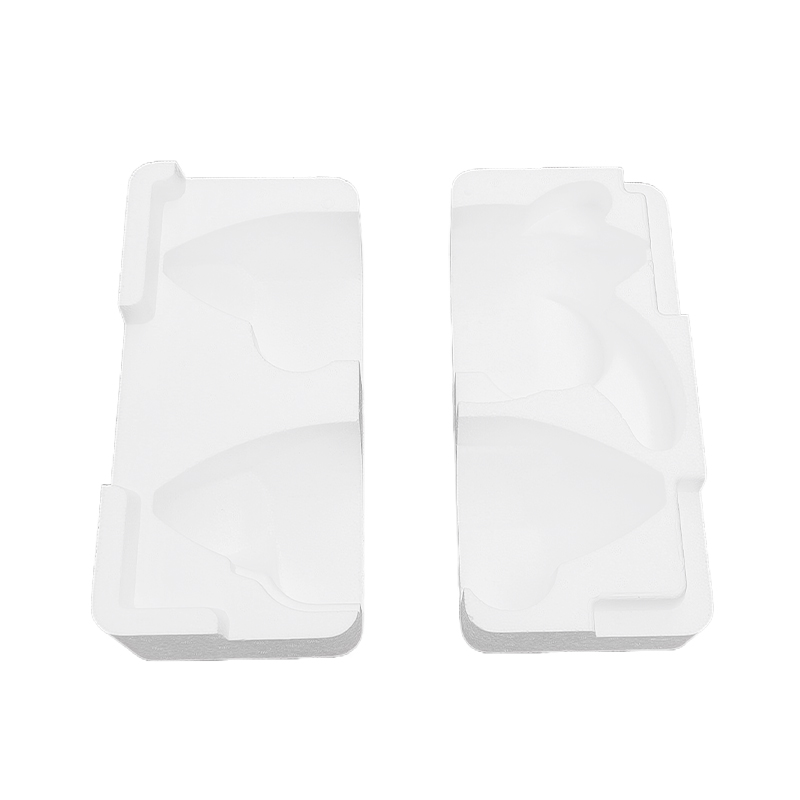
Furthermore, optimization extends beyond overall density to include detailed local structural designs. For example, at bends or end joints where wires are coiled, the EPS inner cavity often employs thickened cushioning or curved transitions to prevent stress concentration; while in straight sections, uniform wrapping is maintained to prevent localized suspension. Some high-end packaging even uses computer simulations to analyze typical impact patterns during transportation, specifically adjusting the foam cell structure in different areas to achieve "on-demand protection."
It's worth noting that the protective effect of EPS is also closely related to its surface treatment. High-quality products ensure smooth, burr-free foam cut surfaces to prevent secondary scratches when inserting or removing wires. Simultaneously, some manufacturers add trace amounts of antistatic ingredients to the formula to reduce electrostatic adsorption caused by friction between the foam and the insulation layer, preventing dust adhesion from affecting subsequent use or testing.
Of course, environmental friendliness and practicality are also crucial. Although EPS itself is recyclable, its lightweight characteristics significantly reduce the overall logistics carbon footprint in single-use scenarios. A well-designed structure can also improve warehousing efficiency—such as nested stacking and standardized outer box dimensions—indirectly supporting green supply chain management.
Ultimately, whether a roll of wire arrives at the user intact often depends on whether that seemingly ordinary white foam "understands" its fragility. When wires EPS packaging can withstand the bumps and knocks during transportation without leaving a single dent on the wire, it is no longer just a simple filler, but a silent promise from precision industry—protecting the integrity of every inch of insulation with just the right amount of softness; bearing the responsibility of safe delivery with scientific elasticity. In this invisible protection, the wisdom of materials lies hidden in that subtle balance between "softness and hardness."
EPS is a lightweight foam material composed of countless closed micropores, and its performance is highly dependent on the foaming process and formulation control. If the density is too low, the foam structure is too loose. While soft, it lacks support and cannot effectively absorb impact energy during stacking or drops, causing the internal wires to be directly subjected to vibration. Conversely, if the density is too high, although it has strong compressive strength, the material is too hard, and prolonged compression may leave indentations on the wire surface, posing a potential threat, especially to softer insulation layers such as PVC and TPE. Truly high-quality wires EPS packaging needs to find a precise balance between these two factors—possessing sufficient structural strength to distribute external pressure while maintaining adequate flexibility and elasticity, so that the wires are "gently wrapped" rather than "tightly bound."
The resilience of wires EPS packaging is another key indicator. Ideally, EPS material should quickly return to its original shape after being deformed under pressure, avoiding permanent deformation that leads to loosening of the inner cavity and causes the wires to shake and rub during transportation. At the same time, good resilience means that the foam can continuously conform to the contours of the wires, maintaining stable support regardless of how many times it is handled during loading and unloading. This dynamic adaptability is particularly important for long-distance transportation or multiple transshipments.
Furthermore, optimization extends beyond overall density to include detailed local structural designs. For example, at bends or end joints where wires are coiled, the EPS inner cavity often employs thickened cushioning or curved transitions to prevent stress concentration; while in straight sections, uniform wrapping is maintained to prevent localized suspension. Some high-end packaging even uses computer simulations to analyze typical impact patterns during transportation, specifically adjusting the foam cell structure in different areas to achieve "on-demand protection."
It's worth noting that the protective effect of EPS is also closely related to its surface treatment. High-quality products ensure smooth, burr-free foam cut surfaces to prevent secondary scratches when inserting or removing wires. Simultaneously, some manufacturers add trace amounts of antistatic ingredients to the formula to reduce electrostatic adsorption caused by friction between the foam and the insulation layer, preventing dust adhesion from affecting subsequent use or testing.
Of course, environmental friendliness and practicality are also crucial. Although EPS itself is recyclable, its lightweight characteristics significantly reduce the overall logistics carbon footprint in single-use scenarios. A well-designed structure can also improve warehousing efficiency—such as nested stacking and standardized outer box dimensions—indirectly supporting green supply chain management.
Ultimately, whether a roll of wire arrives at the user intact often depends on whether that seemingly ordinary white foam "understands" its fragility. When wires EPS packaging can withstand the bumps and knocks during transportation without leaving a single dent on the wire, it is no longer just a simple filler, but a silent promise from precision industry—protecting the integrity of every inch of insulation with just the right amount of softness; bearing the responsibility of safe delivery with scientific elasticity. In this invisible protection, the wisdom of materials lies hidden in that subtle balance between "softness and hardness."