



How does motors EPS packaging provide "double insurance" for motor transportation safety with its superior cushioning performance?
Release Time : 2025-12-10
In industrial manufacturing and logistics, motors, as core power devices, have intricate internal structures and fragile components—especially critical parts such as bearings, stator and rotor windings, and terminals—which are extremely sensitive to vibration, impact, and friction. Damage during transportation or handling can range from affecting operational stability to causing short circuits, jamming, or even complete failure. Motors EPS packaging was developed to address this need. With its precise fit, superior cushioning, lightweight design, and environmental friendliness, it serves as a solid barrier ensuring the safety of motors "from factory to end user," truly providing "double insurance" for transportation safety.
1. Precision Fit: Custom-designed to eliminate displacement and friction
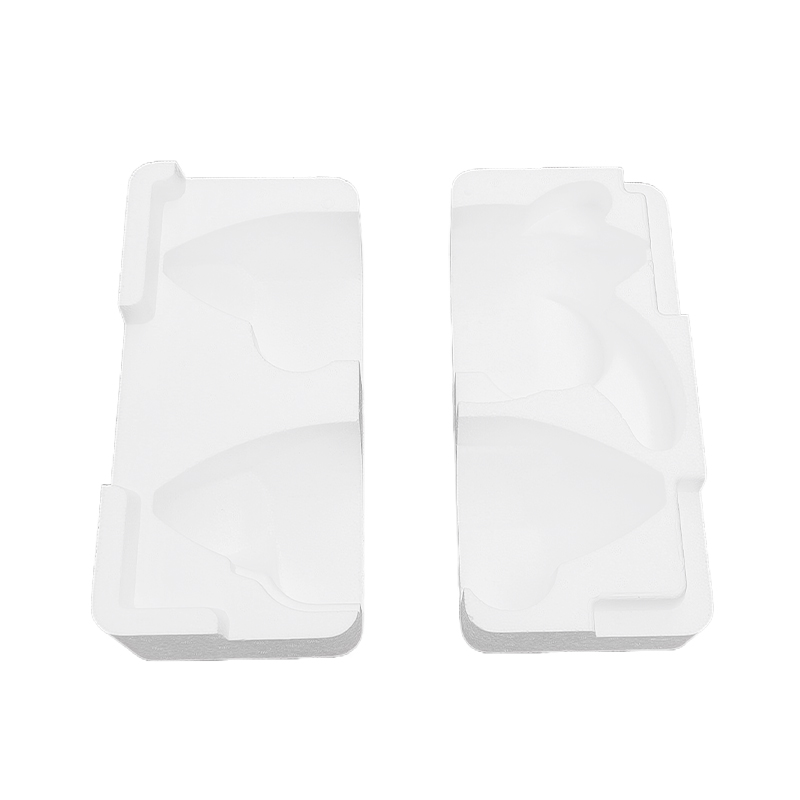
General-purpose packaging is ill-suited for the complex shapes of different motor models—protruding junction boxes, irregular mounting flanges, and slender shaft extensions are prone to collisions or friction with the outer packaging during transportation due to shaking. The EPS foam packaging for motors utilizes 3D scanning and CNC molding technology to precisely replicate the external contours of the motor based on customer-provided drawings or physical samples, achieving a 1:1 full-wrap inner lining design. Whether it's a small servo motor or a large industrial asynchronous motor, the foam cavity can tightly fit every curve and edge of its surface, creating a "floating fixation" effect. This customized fit not only effectively prevents the motor from shifting, rotating, or being impacted within the box, but also avoids direct contact between metal parts and rigid packaging, fundamentally eliminating hidden damage such as paint wear and journal scratches caused by friction.
2. Cushioning and Shock Absorption: Highly Efficient Energy Absorption, Protecting the Precision Internal Structure
EPS material itself has a closed-cell honeycomb structure. Under pressure, it absorbs energy through cell wall bending and gas compression, and can partially recover its original shape after unloading, exhibiting excellent elastic recovery and impact resistance. Addressing common risks during motor transportation such as road bumps, drops during loading and unloading, and stacking compression, EPS foam packaging uses scientifically designed thickness and density, with localized thickening or reinforcement in key stress areas, forming a multi-level cushioning system. Experiments show that in simulated 1.2-meter drop tests, the peak internal acceleration of motors packaged with EPS can be reduced by more than 60%, effectively protecting bearing balls from breakage, winding insulation from damage, and magnets from demagnetization. This "soft yet strong" protective mechanism is particularly suitable for high-risk scenarios such as long-distance sea freight and cross-border logistics.
3. Lightweight and Environmentally Friendly, Enhancing Overall Logistics Efficiency
Compared to wooden crates, molded pulp, or EPE foam, EPS foam is lighter in weight while maintaining the same cushioning performance, significantly reducing overall packaging volume and transportation costs. Simultaneously, its chemical properties are stable, it does not corrode metal surfaces, and it possesses excellent heat insulation and moisture-proof properties, preventing motors from rusting in humid environments. More importantly, modern EPS widely adopts recyclable or bio-based foaming technology, allowing for recycling and regranulation through professional channels after disposal, complying with RoHS, REACH, and other environmental regulations. Some high-end solutions also support modular assembly designs, facilitating disassembly and reuse, further embodying the concept of green packaging.
4. Collaborative Outer Packaging for a Dual Protection System
The EPS liner is not isolated; it works in conjunction with corrugated boxes, wooden pallets, or metal frames to form a dual-protection system of "inner cushioning + outer protection." The inner EPS layer absorbs high-frequency micro-vibrations and instantaneous impacts, while the outer packaging resists punctures, crushing, and environmental corrosion. This synergistic effect ensures the motor remains in a stable, clean, and dry microenvironment throughout the complex logistics chain, significantly reducing damage rates and after-sales disputes.
Motors EPS packaging is far more than just "filler"; it's an intelligent protection solution integrating materials science, structural mechanics, and industrial design. It precisely fits to lock in displacement, provides superior cushioning to absorb impacts, and enhances efficiency through lightweight and environmental friendliness, comprehensively safeguarding the transportation safety of the motor—the "heart of industry."
1. Precision Fit: Custom-designed to eliminate displacement and friction
General-purpose packaging is ill-suited for the complex shapes of different motor models—protruding junction boxes, irregular mounting flanges, and slender shaft extensions are prone to collisions or friction with the outer packaging during transportation due to shaking. The EPS foam packaging for motors utilizes 3D scanning and CNC molding technology to precisely replicate the external contours of the motor based on customer-provided drawings or physical samples, achieving a 1:1 full-wrap inner lining design. Whether it's a small servo motor or a large industrial asynchronous motor, the foam cavity can tightly fit every curve and edge of its surface, creating a "floating fixation" effect. This customized fit not only effectively prevents the motor from shifting, rotating, or being impacted within the box, but also avoids direct contact between metal parts and rigid packaging, fundamentally eliminating hidden damage such as paint wear and journal scratches caused by friction.
2. Cushioning and Shock Absorption: Highly Efficient Energy Absorption, Protecting the Precision Internal Structure
EPS material itself has a closed-cell honeycomb structure. Under pressure, it absorbs energy through cell wall bending and gas compression, and can partially recover its original shape after unloading, exhibiting excellent elastic recovery and impact resistance. Addressing common risks during motor transportation such as road bumps, drops during loading and unloading, and stacking compression, EPS foam packaging uses scientifically designed thickness and density, with localized thickening or reinforcement in key stress areas, forming a multi-level cushioning system. Experiments show that in simulated 1.2-meter drop tests, the peak internal acceleration of motors packaged with EPS can be reduced by more than 60%, effectively protecting bearing balls from breakage, winding insulation from damage, and magnets from demagnetization. This "soft yet strong" protective mechanism is particularly suitable for high-risk scenarios such as long-distance sea freight and cross-border logistics.
3. Lightweight and Environmentally Friendly, Enhancing Overall Logistics Efficiency
Compared to wooden crates, molded pulp, or EPE foam, EPS foam is lighter in weight while maintaining the same cushioning performance, significantly reducing overall packaging volume and transportation costs. Simultaneously, its chemical properties are stable, it does not corrode metal surfaces, and it possesses excellent heat insulation and moisture-proof properties, preventing motors from rusting in humid environments. More importantly, modern EPS widely adopts recyclable or bio-based foaming technology, allowing for recycling and regranulation through professional channels after disposal, complying with RoHS, REACH, and other environmental regulations. Some high-end solutions also support modular assembly designs, facilitating disassembly and reuse, further embodying the concept of green packaging.
4. Collaborative Outer Packaging for a Dual Protection System
The EPS liner is not isolated; it works in conjunction with corrugated boxes, wooden pallets, or metal frames to form a dual-protection system of "inner cushioning + outer protection." The inner EPS layer absorbs high-frequency micro-vibrations and instantaneous impacts, while the outer packaging resists punctures, crushing, and environmental corrosion. This synergistic effect ensures the motor remains in a stable, clean, and dry microenvironment throughout the complex logistics chain, significantly reducing damage rates and after-sales disputes.
Motors EPS packaging is far more than just "filler"; it's an intelligent protection solution integrating materials science, structural mechanics, and industrial design. It precisely fits to lock in displacement, provides superior cushioning to absorb impacts, and enhances efficiency through lightweight and environmental friendliness, comprehensively safeguarding the transportation safety of the motor—the "heart of industry."