



How does batteries EPS packaging effectively absorb impact energy during transportation and protect the structural integrity of lithium batteries through controlled deformation?
Release Time : 2025-12-24
In today's widespread use of lithium batteries—from electric vehicles and energy storage systems to consumer electronics—transportation and warehousing safety has become a core issue in supply chain management. Lithium batteries are extremely sensitive to mechanical shock, compression, and puncture. Damage to the outer casing or deformation of the internal cells can lead to short circuits, thermal runaway, or even fire and explosion. Therefore, battery packaging not only needs basic containment functions but also needs to provide active protection in complex logistics environments.Batteries EPS packaging, with its unique physical structure and designability, has become an ideal choice for battery cushioning. Through a "controlled deformation" mechanism, it efficiently absorbs and dissipates external impact energy within milliseconds, thus comprehensively protecting the structural integrity of lithium batteries.
1. Closed-cell honeycomb structure: The physical basis of energy absorption
EPS packaging is composed of countless closed micro-polystyrene spheres that fuse together through vapor expansion, forming a uniformly distributed closed-cell honeycomb structure. When external impact forces act on the packaging, these micropores first undergo elastic compression, and then enter a plastic collapse stage after exceeding the yield point. This process converts kinetic energy into deformation energy within the foam material and releases it slowly as heat, rather than directly transferring it to the battery body. This "buffer first, dissipate later" mechanism significantly reduces peak impact acceleration, effectively preventing the battery casing from cracking or denting due to instantaneous high stress.
2. Controllable Deformation Design: Precisely Matching Protection Needs
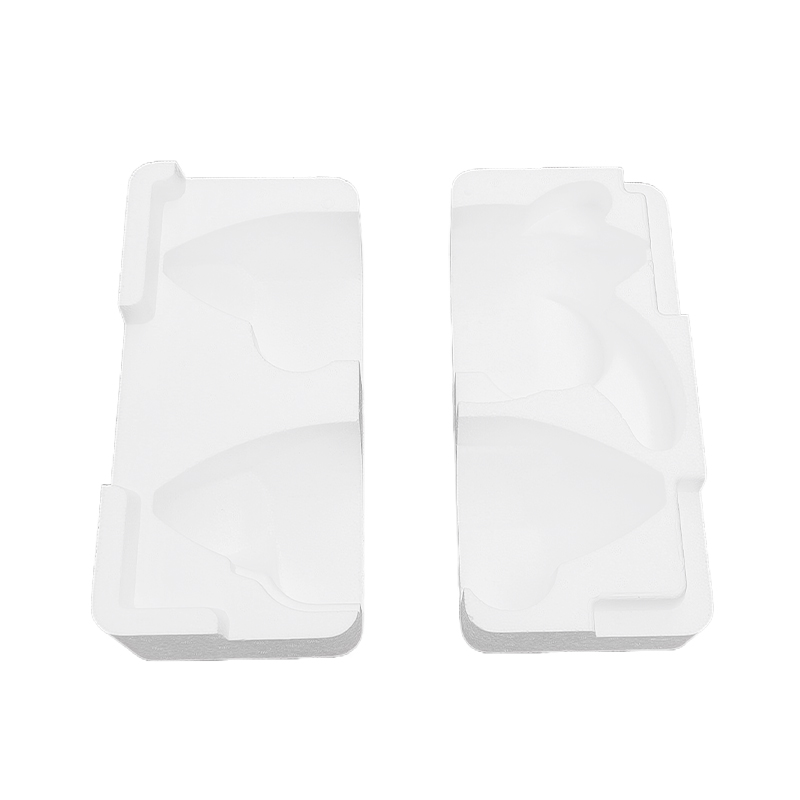
The cushioning performance of battery EPS packaging is not fixed but can be precisely controlled through density, thickness, and geometry. Engineers can customize EPS liners of different densities for lithium batteries of varying weights and sizes. High-density areas bear the main load, while low-density areas provide flexible cushioning. More importantly, precise slots can be created in the EPS through CNC cutting or molding, allowing each battery to be independently embedded in its own cavity, achieving a "zero-gap" fit. This customized structure not only prevents batteries from rubbing against each other or shifting during transportation but also ensures that impact forces are evenly distributed across the entire foam surface, avoiding localized stress concentration.
3. Lightweight and Space Optimization: Enhancing Overall Logistics Safety
Another major advantage of EPS is its extremely low density, providing excellent protection with almost no added weight. For air or long-haul land transport, this translates to lower fuel consumption and carbon emissions. Simultaneously, the tightly fitted, customized design significantly reduces packaging volume, improving the space utilization of containers or pallets. Fewer gaps also mean no room for battery movement within the case, fundamentally eliminating the risk of secondary collisions. This "lightweight yet strong, small yet stable" characteristic allows EPS packaging to significantly improve logistics efficiency and economy while ensuring safety.
4. Environmental Adaptability and Long-Term Reliability
Although EPS is a foam material, its closed-cell structure gives it excellent moisture resistance and dimensional stability. Within normal temperature and humidity ranges, EPS will not soften, age, or release harmful substances, maintaining its cushioning performance for a long time. Even after multiple minor impacts, its remaining protective capacity can still meet subsequent transportation needs. Furthermore, EPS does not contain halogens, heavy metals, or other harmful components, complying with RoHS and REACH environmental requirements. It is also recyclable after disposal, aligning with the trend of green packaging.
The protection offered by batteries EPS packaging for lithium batteries is essentially a physical wisdom of "overcoming hardness with softness." Instead of relying on a hard outer shell to withstand impacts, it gently and firmly resolves every potential threat through controllable and predictable deformation. In modern logistics systems that prioritize safety, efficiency, and sustainability, this seemingly simple white foam is actually an indispensable "invisible shield" protecting the safe distribution of high-energy batteries.
1. Closed-cell honeycomb structure: The physical basis of energy absorption
EPS packaging is composed of countless closed micro-polystyrene spheres that fuse together through vapor expansion, forming a uniformly distributed closed-cell honeycomb structure. When external impact forces act on the packaging, these micropores first undergo elastic compression, and then enter a plastic collapse stage after exceeding the yield point. This process converts kinetic energy into deformation energy within the foam material and releases it slowly as heat, rather than directly transferring it to the battery body. This "buffer first, dissipate later" mechanism significantly reduces peak impact acceleration, effectively preventing the battery casing from cracking or denting due to instantaneous high stress.
2. Controllable Deformation Design: Precisely Matching Protection Needs
The cushioning performance of battery EPS packaging is not fixed but can be precisely controlled through density, thickness, and geometry. Engineers can customize EPS liners of different densities for lithium batteries of varying weights and sizes. High-density areas bear the main load, while low-density areas provide flexible cushioning. More importantly, precise slots can be created in the EPS through CNC cutting or molding, allowing each battery to be independently embedded in its own cavity, achieving a "zero-gap" fit. This customized structure not only prevents batteries from rubbing against each other or shifting during transportation but also ensures that impact forces are evenly distributed across the entire foam surface, avoiding localized stress concentration.
3. Lightweight and Space Optimization: Enhancing Overall Logistics Safety
Another major advantage of EPS is its extremely low density, providing excellent protection with almost no added weight. For air or long-haul land transport, this translates to lower fuel consumption and carbon emissions. Simultaneously, the tightly fitted, customized design significantly reduces packaging volume, improving the space utilization of containers or pallets. Fewer gaps also mean no room for battery movement within the case, fundamentally eliminating the risk of secondary collisions. This "lightweight yet strong, small yet stable" characteristic allows EPS packaging to significantly improve logistics efficiency and economy while ensuring safety.
4. Environmental Adaptability and Long-Term Reliability
Although EPS is a foam material, its closed-cell structure gives it excellent moisture resistance and dimensional stability. Within normal temperature and humidity ranges, EPS will not soften, age, or release harmful substances, maintaining its cushioning performance for a long time. Even after multiple minor impacts, its remaining protective capacity can still meet subsequent transportation needs. Furthermore, EPS does not contain halogens, heavy metals, or other harmful components, complying with RoHS and REACH environmental requirements. It is also recyclable after disposal, aligning with the trend of green packaging.
The protection offered by batteries EPS packaging for lithium batteries is essentially a physical wisdom of "overcoming hardness with softness." Instead of relying on a hard outer shell to withstand impacts, it gently and firmly resolves every potential threat through controllable and predictable deformation. In modern logistics systems that prioritize safety, efficiency, and sustainability, this seemingly simple white foam is actually an indispensable "invisible shield" protecting the safe distribution of high-energy batteries.