



How does Motors EPS Packaging safeguard the transportation of core power components with precise customization?
Release Time : 2025-12-29
In modern industrial systems, motors, as the "heart" driving various equipment, have highly precise internal structures, including fragile components such as stator windings, rotors, bearings, and electronic control modules. Even minor displacement or impact can lead to performance degradation or even functional failure. Therefore, in warehousing, transportation, and handling, a scientific, reliable, and customized Motors EPS packaging (expanded polystyrene cushioning packaging) becomes the first line of defense to ensure product integrity. It is not merely a filler, but an intelligent protection system integrating engineering design, materials science, and logistics needs.
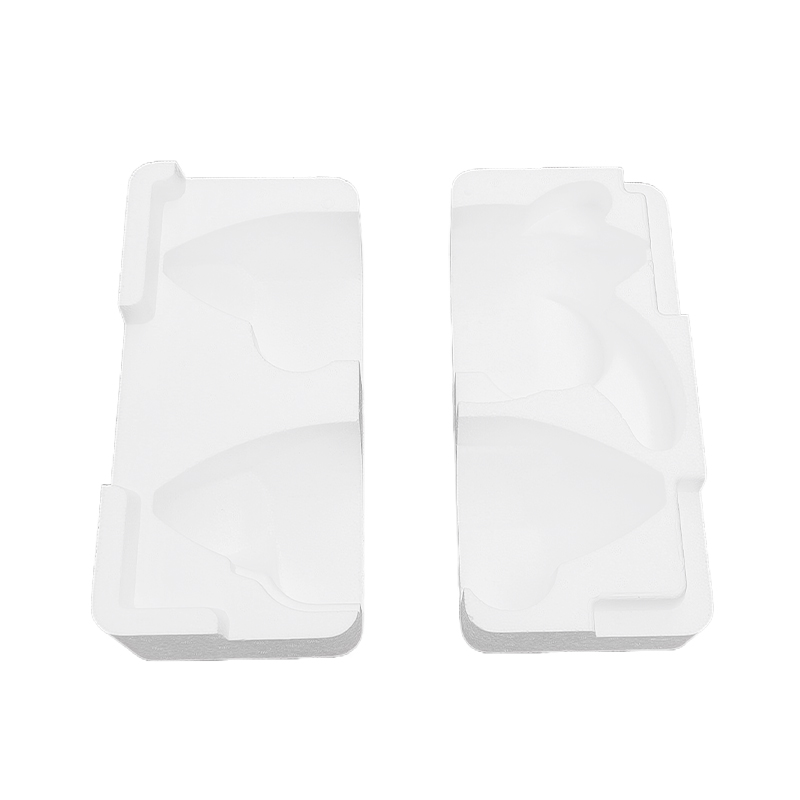
The core advantage of Motors EPS Packaging lies first and foremost in its highly precise fit. Through 3D scanning or CAD modeling, the motor's shape is accurately reproduced, including details such as bosses, junction boxes, heat dissipation fins, and mounting flanges. The EPS liner is CNC-cut or molded into a cavity that perfectly matches the motor surface. After the motor is embedded, there is no room for movement, and all critical components are wrapped and supported by flexible materials. This "tailor-made" packaging effectively prevents metal parts from rubbing against each other, paint scratches, or end cap loosening caused by vibration during transportation, which is especially crucial for high-value products such as servo motors and drive motors for new energy vehicles.
Superior cushioning and shock resistance are inherent properties of EPS material. Its closed-cell honeycomb structure absorbs kinetic energy through elastic deformation of the cell walls under pressure and quickly returns to its original shape after unloading, achieving repeated protection. Whether it's the continuous bumps of long-distance land transportation, the violent shaking in sea transportation, or the accidental drops during air transport, EPS can evenly distribute external impact forces, significantly reducing the peak acceleration transmitted to the motor body. This energy dissipation mechanism significantly reduces the risk of hidden damage such as bearing raceway indentation, winding insulation damage, and magnet demagnetization, ensuring that the motor arrives at the customer's hands still in its factory condition.
At the structural design level, motor EPS packaging often employs multi-layer composite or local reinforcement strategies. High-stress areas, such as bottom corners and around lifting points, are reinforced with increased density or embedded with corrugated cardboard, honeycomb panels, or other reinforcing layers. Internal partitions separate the motor from accessories (such as encoders and fan covers) to prevent collisions. Handle slots or forklift access are provided at the top and bottom for easy manual and mechanical operation. The overall design balances protection, ease of operation, and stacking stability, adapting to automated warehousing environments.
Furthermore, EPS material itself possesses advantages such as lightweight, moisture resistance, and chemical inertness. Its extremely light weight does not increase additional logistics costs; the closed-cell structure prevents moisture penetration, avoiding metal corrosion; and it contains no volatile substances, so it will not contaminate the motor surface or affect electrical performance. After disposal, it can be recycled and granulated; some manufacturers have already adopted renewable raw materials to produce environmentally friendly EPS, responding to green supply chain requirements.
Even more commendable is that this packaging solution supports collaborative optimization throughout the entire product lifecycle. Packaging design is integrated from the early stages of product development, with joint assessment of weaknesses and proactive protection strategies by motor structure engineers; efficient replication is achieved through standardized molds during mass production; and dedicated return/repair boxes are provided in the after-sales process, forming a closed-loop management system.
When a precision motor travels across mountains and rivers to safely arrive at the assembly line, behind it lies the silent protection of EPS packaging, which mitigates risks amidst countless vibrations and impacts. Silent and unseen, it safeguards core value with its millimeter-level fit; unseen, it shoulders the heavy responsibility of transportation with its flexible structure. Because in the logistics logic of high-end manufacturing, true delivery is not just about arrival, but about arriving "intact"—and this is precisely the fundamental meaning of customized motors EPS packaging.
The core advantage of Motors EPS Packaging lies first and foremost in its highly precise fit. Through 3D scanning or CAD modeling, the motor's shape is accurately reproduced, including details such as bosses, junction boxes, heat dissipation fins, and mounting flanges. The EPS liner is CNC-cut or molded into a cavity that perfectly matches the motor surface. After the motor is embedded, there is no room for movement, and all critical components are wrapped and supported by flexible materials. This "tailor-made" packaging effectively prevents metal parts from rubbing against each other, paint scratches, or end cap loosening caused by vibration during transportation, which is especially crucial for high-value products such as servo motors and drive motors for new energy vehicles.
Superior cushioning and shock resistance are inherent properties of EPS material. Its closed-cell honeycomb structure absorbs kinetic energy through elastic deformation of the cell walls under pressure and quickly returns to its original shape after unloading, achieving repeated protection. Whether it's the continuous bumps of long-distance land transportation, the violent shaking in sea transportation, or the accidental drops during air transport, EPS can evenly distribute external impact forces, significantly reducing the peak acceleration transmitted to the motor body. This energy dissipation mechanism significantly reduces the risk of hidden damage such as bearing raceway indentation, winding insulation damage, and magnet demagnetization, ensuring that the motor arrives at the customer's hands still in its factory condition.
At the structural design level, motor EPS packaging often employs multi-layer composite or local reinforcement strategies. High-stress areas, such as bottom corners and around lifting points, are reinforced with increased density or embedded with corrugated cardboard, honeycomb panels, or other reinforcing layers. Internal partitions separate the motor from accessories (such as encoders and fan covers) to prevent collisions. Handle slots or forklift access are provided at the top and bottom for easy manual and mechanical operation. The overall design balances protection, ease of operation, and stacking stability, adapting to automated warehousing environments.
Furthermore, EPS material itself possesses advantages such as lightweight, moisture resistance, and chemical inertness. Its extremely light weight does not increase additional logistics costs; the closed-cell structure prevents moisture penetration, avoiding metal corrosion; and it contains no volatile substances, so it will not contaminate the motor surface or affect electrical performance. After disposal, it can be recycled and granulated; some manufacturers have already adopted renewable raw materials to produce environmentally friendly EPS, responding to green supply chain requirements.
Even more commendable is that this packaging solution supports collaborative optimization throughout the entire product lifecycle. Packaging design is integrated from the early stages of product development, with joint assessment of weaknesses and proactive protection strategies by motor structure engineers; efficient replication is achieved through standardized molds during mass production; and dedicated return/repair boxes are provided in the after-sales process, forming a closed-loop management system.
When a precision motor travels across mountains and rivers to safely arrive at the assembly line, behind it lies the silent protection of EPS packaging, which mitigates risks amidst countless vibrations and impacts. Silent and unseen, it safeguards core value with its millimeter-level fit; unseen, it shoulders the heavy responsibility of transportation with its flexible structure. Because in the logistics logic of high-end manufacturing, true delivery is not just about arrival, but about arriving "intact"—and this is precisely the fundamental meaning of customized motors EPS packaging.