



How can motors EPS packaging achieve efficient and precise molding on an automated production line?
Release Time : 2026-01-08
The efficient and precise molding of Motors EPS packaging on automated production lines relies on the synergistic optimization of equipment, processes, control, and testing technologies. Its core lies in achieving precise control throughout the entire process, from raw material pre-expansion to finished product demolding, through high-precision molds, intelligent control systems, and multi-stage quality monitoring.
Raw material pre-expansion is the first step in Motors EPS packaging molding, and its quality directly affects the stability of subsequent processes. During pre-expansion, steam pressure, heating time, and stirring speed must be adjusted according to the characteristics of the raw material to ensure that the EPS beads fully expand and have uniform density. Fast-expansion materials, due to their low molecular weight and low volatile content, require high-pressure, short-time heating to fully utilize the foaming agent, while standard materials require extended heating time to promote bead softening. After pre-expansion, the beads must be forcibly dried in a fluidized bed to remove surface moisture and promote internal air balance, preventing molding shrinkage or cracking due to residual moisture. The curing stage is equally crucial; the pre-expansion beads must be allowed to stand for a certain period to stabilize their internal pressure, preventing density abnormalities caused by vacuum effects during molding.
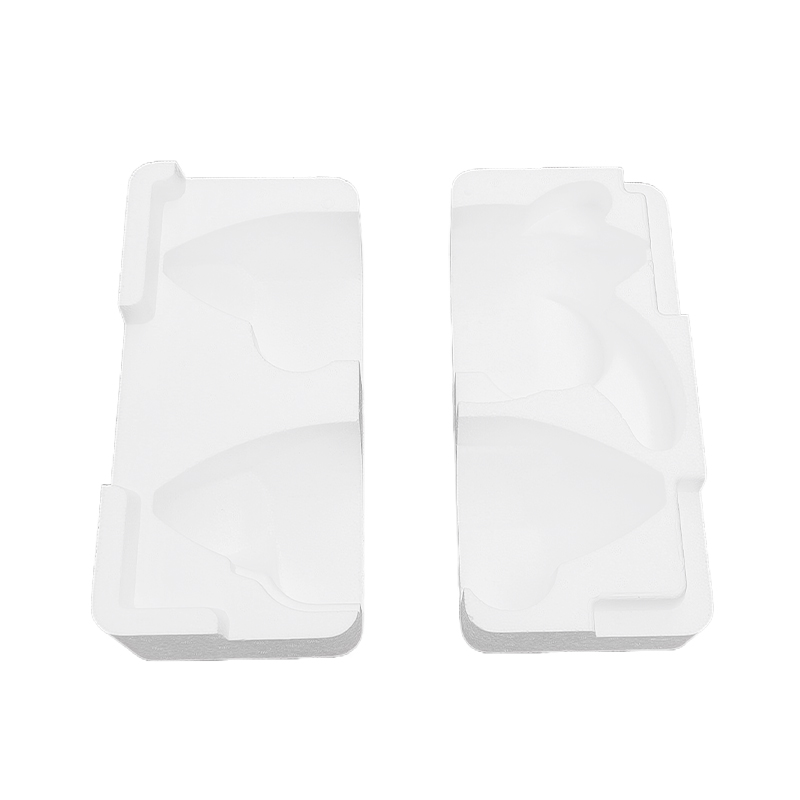
The molding stage is the core of Motors EPS packaging's high efficiency and precision. Automated production lines typically employ fully automated vacuum forming machines. By precisely controlling steam pressure, vacuum level, and mold temperature, they achieve a uniform distribution of the bubble structure. Mold design must consider both the motor shape and cushioning requirements; for example, for vulnerable areas around the motor edges, the mold needs increased thickness or optimized bubble density. During forming, steam must penetrate the bubbles evenly to avoid uneven density caused by localized overheating or underheating. The introduction of a vacuum system quickly removes residual air from the mold, reducing internal porosity and improving surface smoothness and structural strength. Furthermore, some high-end equipment uses ultra-high-speed vacuum pressurization technology, allowing the foam to demold at high temperatures, further shortening the forming cycle and reducing energy consumption.
The application of intelligent control systems is key to improving forming accuracy. Through PLC and HMI systems, parameters such as steam pressure, vacuum level, and mold temperature can be monitored and adjusted in real time to ensure consistency across batches. For example, when sensors detect steam pressure fluctuations, the system automatically compensates for the pressure difference, preventing bubble collapse due to insufficient steam. Simultaneously, the data acquisition system records parameters for each process, enabling production process traceability and providing a basis for process optimization. Some production lines also integrate visual inspection technology to identify appearance defects in the molded products, such as flash, burrs, or surface irregularities, automatically rejecting defective products and improving overall yield.
The precision and maintenance of the molds directly affect the molding quality of Motors EPS packaging. High-precision molds must be made of wear-resistant materials, and the surface finish must meet certain standards to reduce demolding resistance and prevent product sticking. During mold use, residues must be cleaned regularly to avoid uneven cell distribution due to blockage. Furthermore, the mold's cooling system design must be reasonable to ensure rapid cooling of the product after molding, reducing deformation caused by thermal expansion and contraction. Some production lines use high-pressure steam pressure holding technology in upper and lower chambers, ensuring that the foaming material is heated simultaneously on both sides, ensuring uniform foaming of thick-walled products and avoiding structural fragility due to differences in fusion degree.
Optimization of the demolding process is equally important. Automated production lines typically use pneumatic or mechanical demolding devices, precisely controlling demolding force and speed to avoid product damage due to excessive force. After demolding, the product must immediately enter the drying process to remove surface moisture and further stabilize the structure. The drying temperature and time need to be adjusted according to the product's thickness and density to avoid insufficient drying leading to later shrinkage, or over-drying causing surface brittleness.
Quality inspection is the final guarantee for the efficient and precise molding of motors EPS packaging. In addition to visual inspection, the product must undergo dimensional, density, and cushioning performance tests. Dimensional inspection ensures the product fits perfectly to the motor housing, preventing excessive gaps that could cause vibrations during transport; density inspection controls the uniformity of the foam cells to prevent localized low density from affecting the cushioning effect; cushioning performance testing simulates a transport vibration environment to verify the product's ability to protect the motor.
The efficient and precise molding of motors EPS packaging on automated production lines is achieved through optimized raw material pre-expansion, controlled molding processes, the application of intelligent systems, mold precision maintenance, optimized demolding and drying, and multi-stage quality inspection. This process not only improves production efficiency and product consistency but also provides reliable protection for the structural safety of the motor under transport vibration environments.