




Can EPS packaging truly safeguard lithium batteries in harsh logistics environments?
Release Time : 2026-01-22
In the new energy era, lithium batteries are the core power source for electric vehicles, energy storage systems, and portable electronic devices, making their safe transportation a crucial and indispensable link in the industry chain. Unlike ordinary goods, lithium batteries are extremely sensitive to structural integrity—if the casing cracks due to external force, it can lead to internal short circuits, thermal runaway, and even fire risks. For this reason, batteries EPS packaging, with its superior impact and pressure resistance, has become an important barrier to ensure the safety of batteries during handling, stacking, and long-distance transportation.
The essential advantage of EPS material lies in its unique closed-cell foam structure. Countless tiny air pockets are evenly distributed within the material, forming a natural energy absorption network. When an external collision, drop, or compression occurs, these air pockets convert the impact kinetic energy into heat energy through controlled deformation and dissipate it rapidly, thereby significantly reducing the stress transmitted to the battery body. This "soft-to-hard" cushioning mechanism effectively avoids localized concentrated loads caused by hard contact, preventing battery casing deformation, cracking, or cell displacement. Even in multi-layered storage environments, EPS packaging can evenly distribute the weight of the upper layers, maintaining the structural stability of the batteries at the bottom.
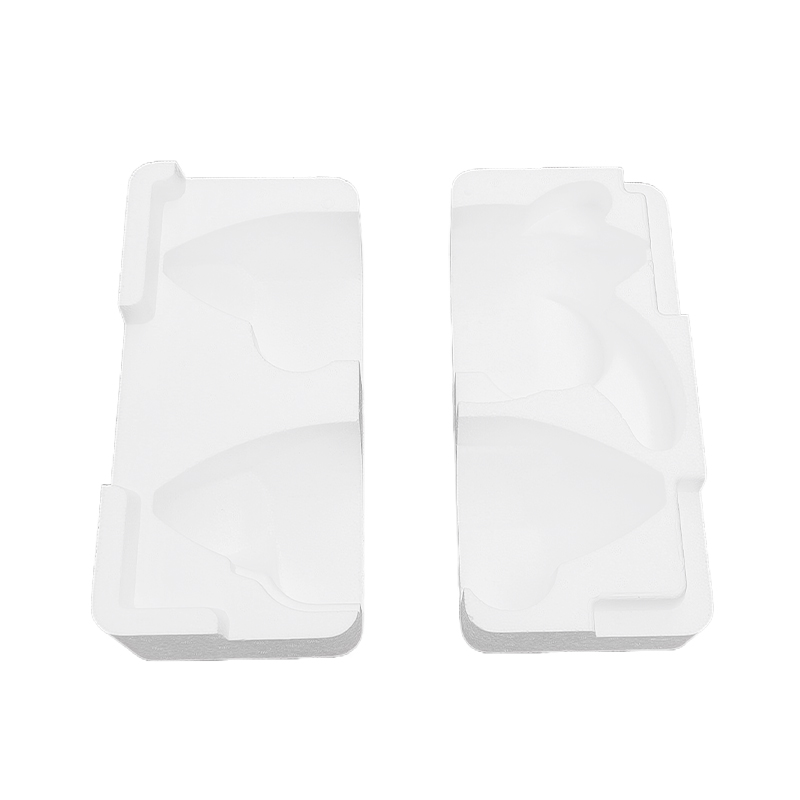
For the specific needs of lithium batteries, EPS packaging design prioritizes precise fit and system protection. Through 3D scanning and digital modeling, the inner lining structure can perfectly conform to the battery's shape, including details such as electrode protrusions, heat dissipation fins, and securing clips. This customized packaging not only restricts any movement of the battery within the box but also prevents static electricity or mechanical damage caused by friction during transportation. Simultaneously, the overall packaging often employs a fully enclosed or semi-embedded structure, coupled with anti-static treatment, further reducing environmental risks. For export transportation, some EPS solutions also integrate humidity indicators and sealing markings to meet international compliance requirements for hazardous chemical packaging.
Beyond physical protection, EPS material itself offers several auxiliary advantages. Its chemical stability prevents reactions with battery electrolytes or metal casings; its low water absorption ensures performance does not degrade in humid environments; and its lightweight nature helps control overall packaging weight and optimize logistics costs. More importantly, EPS is 100% recyclable and can enter the circular economy system at the end of its service life, aligning with the concept of a green supply chain.
In practical applications, this reliability directly translates into a dual guarantee of brand reputation and user safety. An electric vehicle's battery pack remains intact after traveling thousands of kilometers, and a set of energy storage cells exhibits zero performance degradation after multiple transfers—behind this lies the EPS packaging, silently acting as a "shock absorber" and "guardian" in unseen corners. It is unassuming, yet silently withstands every bump and pressure with its resilience; it is understated, yet its precise structure embodies reverence for high-energy products.
Ultimately, the value of battery EPS packaging lies not in the material itself, but in how it transforms scientific principles into a tangible safety commitment. When a high-energy-density lithium battery is securely embedded in white foam, that seemingly simple package is actually a crystallization of engineering wisdom and a sense of responsibility. Because in the chain of energy security, true protection is never a matter of luck, but rather the relentless pursuit of "absolute safety" in every buffer design.
The essential advantage of EPS material lies in its unique closed-cell foam structure. Countless tiny air pockets are evenly distributed within the material, forming a natural energy absorption network. When an external collision, drop, or compression occurs, these air pockets convert the impact kinetic energy into heat energy through controlled deformation and dissipate it rapidly, thereby significantly reducing the stress transmitted to the battery body. This "soft-to-hard" cushioning mechanism effectively avoids localized concentrated loads caused by hard contact, preventing battery casing deformation, cracking, or cell displacement. Even in multi-layered storage environments, EPS packaging can evenly distribute the weight of the upper layers, maintaining the structural stability of the batteries at the bottom.
For the specific needs of lithium batteries, EPS packaging design prioritizes precise fit and system protection. Through 3D scanning and digital modeling, the inner lining structure can perfectly conform to the battery's shape, including details such as electrode protrusions, heat dissipation fins, and securing clips. This customized packaging not only restricts any movement of the battery within the box but also prevents static electricity or mechanical damage caused by friction during transportation. Simultaneously, the overall packaging often employs a fully enclosed or semi-embedded structure, coupled with anti-static treatment, further reducing environmental risks. For export transportation, some EPS solutions also integrate humidity indicators and sealing markings to meet international compliance requirements for hazardous chemical packaging.
Beyond physical protection, EPS material itself offers several auxiliary advantages. Its chemical stability prevents reactions with battery electrolytes or metal casings; its low water absorption ensures performance does not degrade in humid environments; and its lightweight nature helps control overall packaging weight and optimize logistics costs. More importantly, EPS is 100% recyclable and can enter the circular economy system at the end of its service life, aligning with the concept of a green supply chain.
In practical applications, this reliability directly translates into a dual guarantee of brand reputation and user safety. An electric vehicle's battery pack remains intact after traveling thousands of kilometers, and a set of energy storage cells exhibits zero performance degradation after multiple transfers—behind this lies the EPS packaging, silently acting as a "shock absorber" and "guardian" in unseen corners. It is unassuming, yet silently withstands every bump and pressure with its resilience; it is understated, yet its precise structure embodies reverence for high-energy products.
Ultimately, the value of battery EPS packaging lies not in the material itself, but in how it transforms scientific principles into a tangible safety commitment. When a high-energy-density lithium battery is securely embedded in white foam, that seemingly simple package is actually a crystallization of engineering wisdom and a sense of responsibility. Because in the chain of energy security, true protection is never a matter of luck, but rather the relentless pursuit of "absolute safety" in every buffer design.