



How can EPS fillers provide customized transport protection for home appliances with their tailored structure?
Release Time : 2026-01-26
On the journey of home appliances from the factory to thousands of homes, every handling, loading and unloading, and long-distance transportation carries hidden risks. Screens may crack due to vibration, delicate components inside compressors may shift due to impact, and circuit boards on control panels are extremely sensitive to collisions. For these high-value, complex, and fragile home appliances, generic packaging often falls short. Customized EPS (expanded polystyrene) filler, with its high plasticity and excellent cushioning performance, is precisely designed to fit the product's contours, creating an "invisible armor" for each appliance inside the shipping box, providing comprehensive protection from overall wrapping to localized reinforcement.
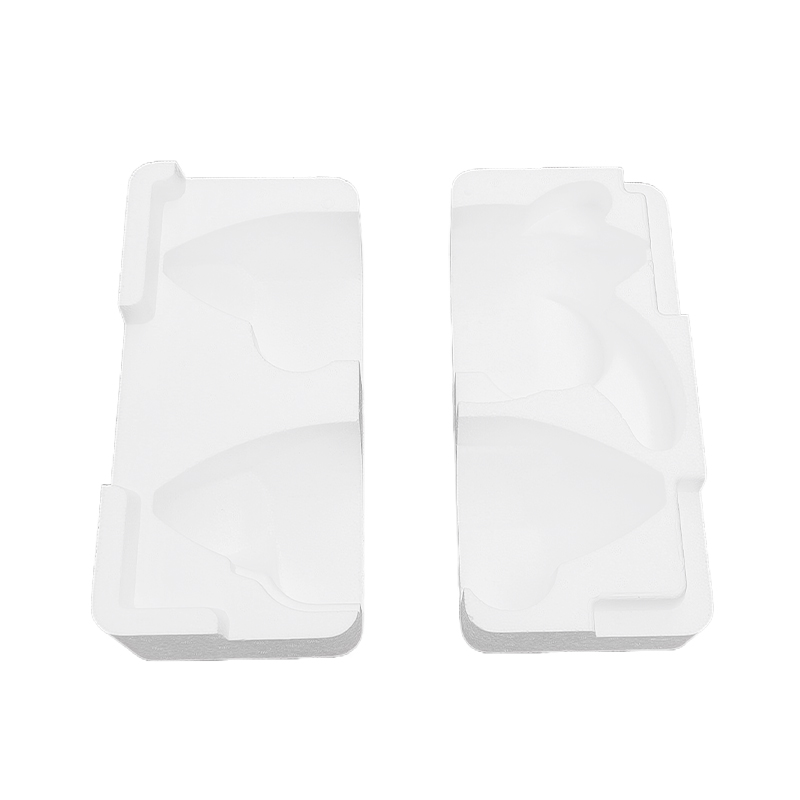
Its core advantage stems from its highly personalized structural adaptability. Unlike the rough filling of standard foam blocks, customized EPS filler uses 3D modeling and CNC cutting based on the appliance's specific shape, center of gravity distribution, and vulnerable areas. In the screen area, a deeply recessed groove is designed to completely submerge the glass panel within the foam, with even coverage on all sides. At the compressor base, a thickened support platform and limiting protrusions are installed to prevent the device from sliding within the box. For protruding knobs, interfaces, or heat sinks, precise holes or partial cutouts are provided to prevent deformation under pressure. This "one-size-fits-all" design logic ensures the appliance remains rock-solid within the packaging, eliminating any room for movement even during severe bumps, fundamentally eliminating friction and impact.
More importantly, the energy absorption mechanism of the EPS material itself is crucial. Its interior consists of countless closed micropores. When external impact is received, the pores deform under pressure, converting kinetic energy into heat energy and dissipating it rapidly, thus significantly reducing the peak impact transmitted to the appliance. This cushioning effect does not rely on simply increasing thickness, but rather on a rational layout—increasing wall thickness or using multi-layered structures in high-risk areas, and appropriately thinning in non-critical areas to save material—achieving the optimal balance between efficiency and cost. Especially for brittle components such as glass, ceramics, or precision electronic parts, EPS's progressive energy absorption characteristics are more effective than rigid materials in preventing breakage caused by instantaneous stress concentration.
Furthermore, the balance between environmental friendliness and practicality is crucial. Modern EPS fillers are mostly made from recyclable materials and can be compressed after disposal, reducing their volume. Their dense, smooth surface prevents lint buildup, avoiding contamination of electrical appliances. They are also lightweight, minimizing transportation burden. Some high-end solutions incorporate anti-static formulations to protect control panels with sensitive circuitry, preventing electrostatic discharge damage to components.
It's worth noting that customization does not equate to inefficiency. Thanks to digital design and automated molding technology, the cycle from customer drawings to finished fillers has been significantly shortened. A single set of molds can mass-produce highly consistent products, ensuring that every package provides the same level of protection. This "flexible customization + economies of scale" model makes it widely applicable to various product categories, including televisions, refrigerators, washing machines, air conditioners, and even high-end kitchen appliances.
Ultimately, the value of EPS fillers lies not in their conspicuousness, but in their silent, seamless fit, mitigating the immense pressure of travel. It doesn't participate in product functionality, yet it ensures the product arrives at the user's hands intact; seemingly simple, it is the culmination of collaborative industrial design, materials science, and logistics safety.
Because in the underlying logic of modern logistics, the best protection is to quietly eliminate risks before they arrive. And that custom-made EPS filler, silently encasing the appliance, is the most precise and gentle embodiment of this silent protection.
Its core advantage stems from its highly personalized structural adaptability. Unlike the rough filling of standard foam blocks, customized EPS filler uses 3D modeling and CNC cutting based on the appliance's specific shape, center of gravity distribution, and vulnerable areas. In the screen area, a deeply recessed groove is designed to completely submerge the glass panel within the foam, with even coverage on all sides. At the compressor base, a thickened support platform and limiting protrusions are installed to prevent the device from sliding within the box. For protruding knobs, interfaces, or heat sinks, precise holes or partial cutouts are provided to prevent deformation under pressure. This "one-size-fits-all" design logic ensures the appliance remains rock-solid within the packaging, eliminating any room for movement even during severe bumps, fundamentally eliminating friction and impact.
More importantly, the energy absorption mechanism of the EPS material itself is crucial. Its interior consists of countless closed micropores. When external impact is received, the pores deform under pressure, converting kinetic energy into heat energy and dissipating it rapidly, thus significantly reducing the peak impact transmitted to the appliance. This cushioning effect does not rely on simply increasing thickness, but rather on a rational layout—increasing wall thickness or using multi-layered structures in high-risk areas, and appropriately thinning in non-critical areas to save material—achieving the optimal balance between efficiency and cost. Especially for brittle components such as glass, ceramics, or precision electronic parts, EPS's progressive energy absorption characteristics are more effective than rigid materials in preventing breakage caused by instantaneous stress concentration.
Furthermore, the balance between environmental friendliness and practicality is crucial. Modern EPS fillers are mostly made from recyclable materials and can be compressed after disposal, reducing their volume. Their dense, smooth surface prevents lint buildup, avoiding contamination of electrical appliances. They are also lightweight, minimizing transportation burden. Some high-end solutions incorporate anti-static formulations to protect control panels with sensitive circuitry, preventing electrostatic discharge damage to components.
It's worth noting that customization does not equate to inefficiency. Thanks to digital design and automated molding technology, the cycle from customer drawings to finished fillers has been significantly shortened. A single set of molds can mass-produce highly consistent products, ensuring that every package provides the same level of protection. This "flexible customization + economies of scale" model makes it widely applicable to various product categories, including televisions, refrigerators, washing machines, air conditioners, and even high-end kitchen appliances.
Ultimately, the value of EPS fillers lies not in their conspicuousness, but in their silent, seamless fit, mitigating the immense pressure of travel. It doesn't participate in product functionality, yet it ensures the product arrives at the user's hands intact; seemingly simple, it is the culmination of collaborative industrial design, materials science, and logistics safety.
Because in the underlying logic of modern logistics, the best protection is to quietly eliminate risks before they arrive. And that custom-made EPS filler, silently encasing the appliance, is the most precise and gentle embodiment of this silent protection.