



How does Motors EPS Packaging achieve comprehensive cushioning and shock absorption by precisely matching the motor's shape through structural design?
Release Time : 2026-02-05
During the transportation and storage of motors, even slight bumps or drops can cause displacement, deformation, or even breakage of internal precision components—such as bearings, rotors, stator windings, or encoders—leading to performance degradation or direct failure. Motors EPS Packaging, with its superior cushioning performance, lightweight characteristics, and high customizability, has become the preferred material for motor packaging. Its core protective capability relies not only on the material itself but also on a refined structural design based on the motor's three-dimensional morphology. Through a "tailor-made" inner liner, it achieves comprehensive, all-around protection for critical components.
1. Reverse Modeling: From Motor Body to Digital Twin
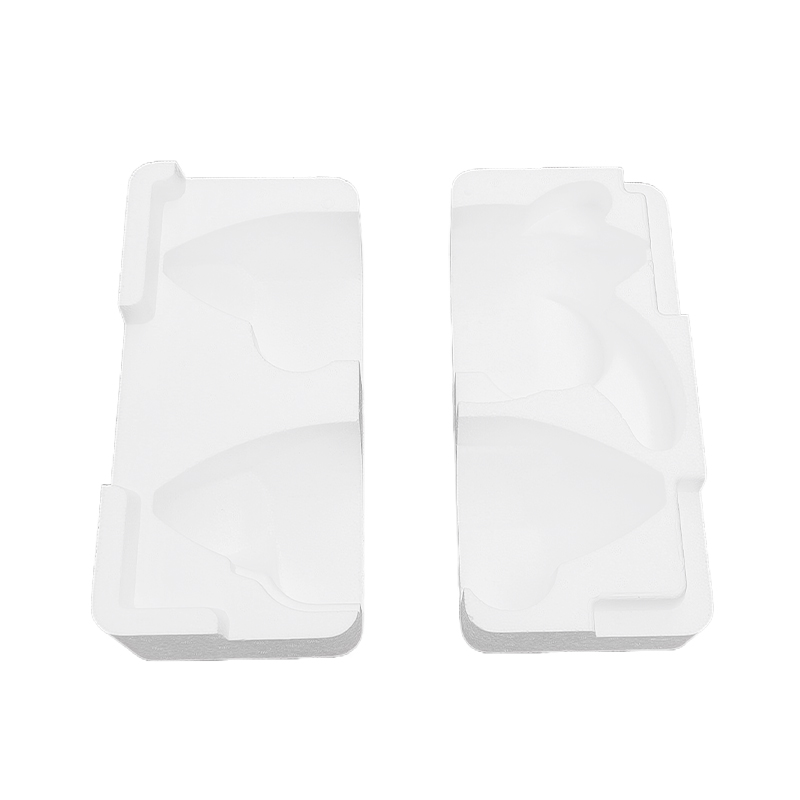
The design of Motors EPS Packaging begins with precise data acquisition of the motor itself. Engineers obtain complete geometric information of the motor casing through 3D scanning or CAD model import, including all protrusions and recesses such as mounting flanges, junction boxes, cooling fins, and lifting eyelet holes. Based on this, professional packaging simulation software is used for reverse modeling to generate an inner liner cavity that perfectly fits the motor surface. This "negative-shape" design ensures maximum contact surface and uniform stress distribution after the motor is placed inside, avoiding concentrated impacts caused by localized suspension or point contact.
2. Zoned Buffering: Reinforcing Critical Areas as Needed
Not all parts require equal strength of protection. The EPS liner adopts a functional zoned design concept:
Bearing end and shaft extension end: As the most vulnerable areas, a thickened buffer layer is set, and an independent limiting groove is designed to prevent axial movement;
Junction box and sensor area: Locally deepened cavities and side walls are used to avoid direct impact during tipping;
Motor bottom and top: Honeycomb-shaped reinforcing ribs or pyramid structures are added to improve compressive strength and prevent stacking deformation;
Center for gravity balance zone: By adjusting the wall thickness distribution, the overall center of gravity is centered, reducing swaying during transportation.
This "soft where it needs to be soft, hard where it needs to be hard" strategy saves materials while precisely targeting protective resources to high-risk areas.
3. Energy Absorption Mechanism: Scientific Energy Dissipation of Closed-Cell Structure
EPS is composed of countless closed microspheres filled with air. When impacted, the cell walls elastically bend or locally buckle, converting kinetic energy into heat and deformation energy; after the impact, most of the structure returns to its original shape. More importantly, by adjusting the foaming ratio, EPS with different hardness can be customized—high-density areas are used for load-bearing support, while low-density areas are used for flexible energy absorption. This gradient design allows the packaging to withstand both high-frequency, small-amplitude vibrations and absorb low-frequency, large-amplitude impacts, effectively isolating it from multiple threats such as road bumps and drops during loading and unloading.
4. Integrated Molding and Assembly Convenience
Modern EPS liners are mostly molded in one piece, eliminating the need for adhesives or splicing, thus preventing the risk of loosening caused by secondary assembly. The liner is often designed as a two-part structure, with the motor inserted and then fastened. Some high-end solutions also integrate handle slots, strapping slots, or RFID tag embedding ports, improving logistics efficiency. Simultaneously, the EPS surface can be coated with an antistatic film or sprayed with an antistatic agent to prevent dust adsorption and potential interference from electrostatic discharge to the motor control circuit.
Motor EPS packaging is far more than a simple "foam sleeve"; it's an intelligent protective system that integrates industrial design, materials mechanics, and logistics engineering. With millimeter-level precision, it encases the steel body, using its flexibility to absorb powerful impacts, silently safeguarding each motor throughout its journey from factory to end user. It is this harmonious blend of strength and flexibility that makes EPS an indispensable safety cornerstone in the modern electromechanical product supply chain.
1. Reverse Modeling: From Motor Body to Digital Twin
The design of Motors EPS Packaging begins with precise data acquisition of the motor itself. Engineers obtain complete geometric information of the motor casing through 3D scanning or CAD model import, including all protrusions and recesses such as mounting flanges, junction boxes, cooling fins, and lifting eyelet holes. Based on this, professional packaging simulation software is used for reverse modeling to generate an inner liner cavity that perfectly fits the motor surface. This "negative-shape" design ensures maximum contact surface and uniform stress distribution after the motor is placed inside, avoiding concentrated impacts caused by localized suspension or point contact.
2. Zoned Buffering: Reinforcing Critical Areas as Needed
Not all parts require equal strength of protection. The EPS liner adopts a functional zoned design concept:
Bearing end and shaft extension end: As the most vulnerable areas, a thickened buffer layer is set, and an independent limiting groove is designed to prevent axial movement;
Junction box and sensor area: Locally deepened cavities and side walls are used to avoid direct impact during tipping;
Motor bottom and top: Honeycomb-shaped reinforcing ribs or pyramid structures are added to improve compressive strength and prevent stacking deformation;
Center for gravity balance zone: By adjusting the wall thickness distribution, the overall center of gravity is centered, reducing swaying during transportation.
This "soft where it needs to be soft, hard where it needs to be hard" strategy saves materials while precisely targeting protective resources to high-risk areas.
3. Energy Absorption Mechanism: Scientific Energy Dissipation of Closed-Cell Structure
EPS is composed of countless closed microspheres filled with air. When impacted, the cell walls elastically bend or locally buckle, converting kinetic energy into heat and deformation energy; after the impact, most of the structure returns to its original shape. More importantly, by adjusting the foaming ratio, EPS with different hardness can be customized—high-density areas are used for load-bearing support, while low-density areas are used for flexible energy absorption. This gradient design allows the packaging to withstand both high-frequency, small-amplitude vibrations and absorb low-frequency, large-amplitude impacts, effectively isolating it from multiple threats such as road bumps and drops during loading and unloading.
4. Integrated Molding and Assembly Convenience
Modern EPS liners are mostly molded in one piece, eliminating the need for adhesives or splicing, thus preventing the risk of loosening caused by secondary assembly. The liner is often designed as a two-part structure, with the motor inserted and then fastened. Some high-end solutions also integrate handle slots, strapping slots, or RFID tag embedding ports, improving logistics efficiency. Simultaneously, the EPS surface can be coated with an antistatic film or sprayed with an antistatic agent to prevent dust adsorption and potential interference from electrostatic discharge to the motor control circuit.
Motor EPS packaging is far more than a simple "foam sleeve"; it's an intelligent protective system that integrates industrial design, materials mechanics, and logistics engineering. With millimeter-level precision, it encases the steel body, using its flexibility to absorb powerful impacts, silently safeguarding each motor throughout its journey from factory to end user. It is this harmonious blend of strength and flexibility that makes EPS an indispensable safety cornerstone in the modern electromechanical product supply chain.